
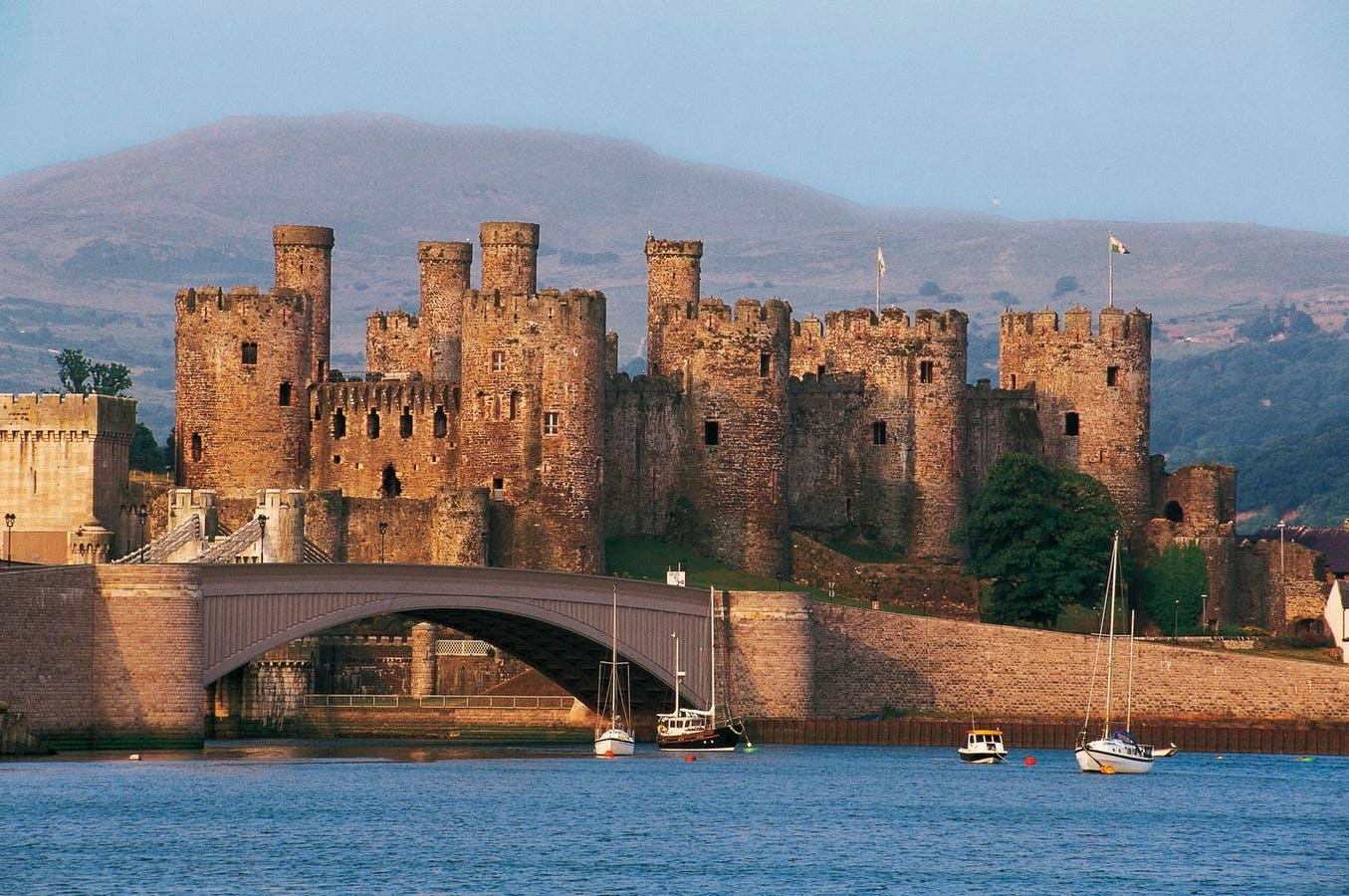
Conway Castle in Conwy, Wales, is located in North Wales. It was built by Edward I, during his conquest of Wales, between 1283 and 1287.
De Agostini via Getty Images
The Papal Conclave in May was a reminder of a tradition that assumed its modern form in the 13th century. Medieval History is chic again. A trip to the Vatican is just the starting point for the perfect luxury travel guide of Europe’s iconic Medieval destinations, from the Vatican City to Conway Castle in Wales, paired with 5-star hotels to make Father’s Day a luxury.
Italy
Rome Cavalieri, a Waldorf Astoria Hotel, Garden Lobby – Nervi Staircase. The hotel overlooks the city from Monte Mario, about 15 minutes from the city center
© Antonio Saba
Any tour of Medieval Europe must begin in Rome. Present-day Vatican City was the seat of the papacy in the Middle Ages, with only some back and forth; from 1309-77 it was in Avignon, until Gregory XI returned the papacy to its current home. Rome Cavalieri, A Waldorf Astoria Hotel overlooks the city from Monte Mario, about 15 minutes from the city center. Any of the “Rome view” suites, or the luxurious Penthouse, offer ideal vistas for scoping out the Eternal City before Dad ventures out to St. Peter’s Basilica, the Vatican museums, and the Sistine Chapel.
France
The Domaine des Etangs, Auberge Resorts Collection is a 13th-century luxury resort on 2,500 acres of forests, lakes, meadows, and gardens in southwestern France
insta: @manuheslop
The knights of Chasteignier de la Roche-Posay hold a significant role in medieval history. Like many noble families of the era, they were closely tied to the chivalric traditions and responsibilities that defined medieval knighthood. They also built a 13th-century château that houses a luxury resort (Domaine des Etangs, Auberge Resorts Collection) set on 2,500 acres of forests, lakes, meadows, and gardens in southwestern France. Once the private estate of the Primat family, today the property exudes the grandeur of the medieval era in modern luxury: stone barns, a floating tennis court, and historic architecture that whispers stories of the past. When in the village of Massignac, Dad can visit the Château de Massignac, a 15th-century castle located in the nearby commune of Alloue; or the Dolmen de Tauzat, a Neolithic-era burial chamber.
Exterior of Notre Dame Cathedral in Paris, France’s most famous medieval monument.
© Yannick Boschat Diocèse de Paris
When in Paris, stay at the Hotel de Crillon, constructed in 1758 as a private mansion and designed by Ange-Jacques Gabriel, the principal architect of Louis XV. Among its 36 suites and 10 signature suites: Les Grands Appartements, created by Karl Lagerfeld, which blend luxury accommodations and historic architecture two blocks from the River Seine and steps from the Place de la Concorde.
Turkey
Ayasofya, Hagia Sophia, was a Greek Orthodox Christian patriarchal basilica, later an imperial mosque, and now a museum in Istanbul, Turkey.
getty
When it was Constantinople, the seat of the Byzantine Empire, Istanbul was the cultural and political hub of Europe’s most important empire in the Middle Ages. It’s still home to the Hagia Sophia, which was constructed in the fourth century and still stands as perhaps the grandest testament to Byzantine architecture. Today, it’s an active mosque as well as the home to a remarkable collection of medieval Byzantine mosaics spanning from the sixth to the 14th century.
When in Istanbul, stay at the Pera Palace Hotel, which first opened its doors in 1892 to passengers on the Orient Express. Since then, it’s hosted Agatha Christie (who wrote part of Murder on the Orient Express in Room 411) and Mustafa Kemal Atatürk (the founder of modern Turkey, who frequently stayed in Room 101), among other dignitaries. For Father’s Day, book dad into a spacious suite named for one of the property’s famous guests, including Mata Hari, Ernest Hemingway, or Alfred Hitchcock.
Germany
City of Aachen, West Germany is the perfect home base for exploring Germany’s Rhineland, with its idyllic vineyards and historic castles, or taking a Rhine River castle cruise for a sip of history with your Riesling.
getty
In 800, Pope Leo III crowned the Frankish king Charlemagne as the emperor of Rome. Charlemagne in turn, chose Aachen, which today shares a western border with Belgium and the Netherlands, as the seat of the Carolingian Empire. It’s the perfect home base for exploring Germany’s Rhineland, with its idyllic vineyards and historic castles, or taking a Rhine River castle cruise for a sip of history with your Riesling. The Aachen Cathedral Treasury (Aachener Domschatzkammer) holds the most important collection of church artworks North of the Alps Book a well-appointed suite for Dad at the Quellenhof Aaachen, one of Germany’s first grand hotels since its 1912 opening. Its Fireplace and Tea Lounge is the perfect setting for relaxing reading — or reflecting on a day about Aachen’s old town.
Wales
Sunset view of Conwy Castle in Conwy, Wales. Wales boasts the highest density of castles per square mile in the world — thanks to the brutal Wars of Welsh Subjugation.
getty
For dads who would rather scale a turret than walk a golf course, Wales boasts the highest density of castles per square mile in the world — thanks to the brutal Wars of Welsh Subjugation. Start in the town of Conwy, a living diorama of feudal life. The walled market town features the castles of the Master of St. James, a famed medieval architect responsible for designing King Edward I’s castles in North Wales in the 13th century, and the 16th-century Plas Mawr town in the heart of town on High Street. Stay at The Castle Hotel, also on High Street, a cozy former coaching inn that dates to the 15th century.
Spain
Santiago de Compostela Cathedral, Galicia, Spain was constructed between the 11th and 13th centuries. The cathedral’s exalted status brought about the Camino de Santiago (Way of St. James), roads that connected much of medieval Europe
getty
Santiago de Compostela Cathedral, along the North Coast of Spain in Galicia, is traditionally believed to house the tomb of Saint James the Apostle, making it one of the most important Christian pilgrimage destinations alongside Jerusalem and Rome. Constructed between the 11th and 13th centuries the cathedral’s exalted status brought about the Camino de Santiago (Way of St. James), roads that connected much of medieval Europe. The Parador de Santiago de Compostela claims to be Spain’s oldest hotel, dating to 1501. It features Renaissance and baroque architecture, the largest collection of Madrid School paintings in the Paradors collection, and luxurious rooms all contained within a UNESCO World Heritage site.
London
Westminster Abbey (rebuilt by Edward the Confessor in the 11th century), and Smithfield Market (known since the 12th century for its livestock market, and formerly the site of public executions) are just a few of the city’s must-see sites
getty
The Tower of London, founded in 1066 by William the Conqueror, played a central role in medieval power, intrigue, and imprisonment. It’s the highlight of the UK capital’s remarkably well-preserved medieval sites of interest. The Temple Church (founded in the 12th century by the Knights Templar), Westminster Abbey (rebuilt by Edward the Confessor in the 11th century), and Smithfield Market (known since the 12th century for its livestock market, and formerly the site of public executions) are just a few of the city’s must-see sites. The centrally located Savoy Hotel overlooks the River Thames and has been a symbol of luxury since its opening in 1889. It combines the best of British service along with several palatially appointed suites with river views — all within walking distance of historic London.
Ireland
Cashel Palace Hotel, Cashel, Tipperary, Ireland, Historic Hotel 5 Star, Drawing Room
© Michelle Chaplow / Hotel Essence Photography / hotel Photographer. All rights reserved www.michellechaplow.com
Any use of t
Perched on a limestone outcrop in the heart of the Golden Vale, the Rock of Cashel was once the seat of the High Kings of Munster and the site where St. Patrick is said to have converted King Aenghus to Christianity. Today, it remains a captivating complex of Romanesque and Gothic architecture, including a 13th-century cathedral, a 12th-century chapel adorned with Ireland’s only surviving Romanesque frescoes, and a 28-meter round tower — all set against a backdrop of rolling green hills and farmland. Eleven miles north sits the Cahir Castle, originally built in 1142 by Conor O’Brien, Prince of Thomond — an underrated medieval jewel used often in filming. When in County Tipperary, stay at the Cashel Palace Hotel, a five-star Relais & Châteaux property set within a meticulously restored Palladian manor dating to 1732.
Scotland
Edinburgh’s Castle dates to the 12th century under King David I, and served as the primary royal residence during the medieval period.
getty
Edinburgh Castle and the Royal Mile, which runs from Holyrood House to Edinburgh Cathedral, stand as the symbolic and practical centers of Scottish medieval power, culture, and conflict. Edinburgh’s castle dates to the 12th century under King David I, and served as the primary royal residence during the medieval period, especially before the rise of Holyrood Palace. Historians view the Royal Mile as a rare surviving example of medieval urban planning, making it the perfect walk for medieval historians. Stay at The Witchery, one of Scotland’s most famous hotel-restaurants, dating to 1595, hidden in a collection of historic buildings at the gates of Edinburgh Castle. The gothic-themed hotel leans into its storied past with a flair for dramatic details from floor to ceiling. Continue the fantasy by driving to Stirling Castle, Glamis Castle, and Dunottar Castle — all within an hour or two of Edinburgh — for a broader look at Scotland’s medieval past.
Immerse dad in the Knights Templar ruins, sleep in a 15th-century Welsh castle and travel through time on this unforgettable journey for Father’s Day.